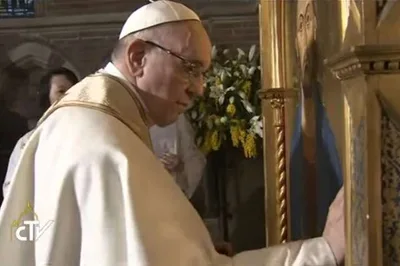
And he carries out this service, this ministry according to the mercy shown him,” he said, adding that this ministry is done “not on the basis of his ability, nor by relying on his own strength, but by trusting that God is watching over him and sustaining his weakness with mercy.” To become humble, he said, “means drawing attention away from oneself, recognizing one’s dependence on God as a beggar of mercy: this is the starting point so that God may work in us.” Francis then quoted a former president of the World Council of Churches, who described Christian evangelization as “a beggar telling another beggar where he can find bread.” “I believe Saint Paul would approve,” he said, because “he grasped the fact that he was fed by mercy and that his priority was to share his bread with others: the joy of being loved by the Lord, and of loving him.” Pope Francis spoke to a crowd of both Catholic and Anglican faithful during his Feb. The visit, he said, “is a grace and also a responsibility: the responsibility of strengthening our ties, to the praise of Christ, in service of the Gospel and of this city.” Francis closed his homily encouraging both Catholics and Anglicans to work together “to become ever more faithful disciples of Jesus, always more liberated from our respective prejudices from the past and ever more desirous to pray for and with others.” After his homily, Pope Francis took three questions from the congregation on the state of Catholic-Anglican relations today, his approach to relations versus that of his direct predecessor Benedict XVI and what Catholics and Anglicans can learn from the “creativity” of Churches in the global south, specifically Africa and Asia. Theological questions are important, he said, noting that there are “many things in which we still don’t agree.” But having this discussion “can’t be done in a laboratory, it has to be done walking,” he said, explaining that “we are on a journey.” It’s important to have these theological discussions, “but in the meantime we help each other” though acts of charity such as serving the poor, migrants and refugees, he said, adding that “you can’t have ecumenical dialogue that is stopped…you have to do it walking.” When responding to the third question, Pope Francis noted that “young Churches” in Africa and Asia do have “a different vitality because they are different and they look for ways to express themselves differently.” However, the “older Churches” in European countries, also have their own benefits, he said, noting that they have had time to “mature” and deepen in many things, including theological and ecumenical questions.