Quiapo Church elevated as ‘Archdiocesan Shrine of the Black Nazarene’
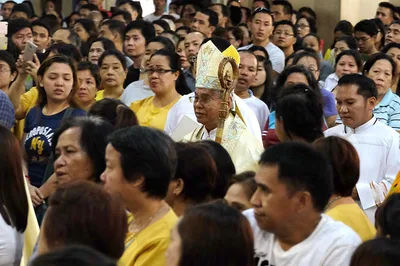
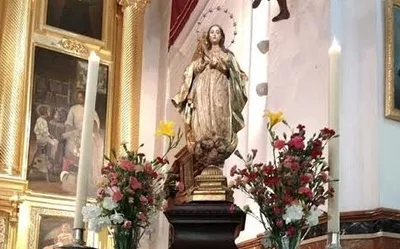
The St. John the Baptist Parish or Quiapo Church has been elevated to the status of an archdiocesan shrine.
By the roadside “What have you done? Your brother’s blood cries out to me from the ground. Now you are cursed from the ground, which has opened its mouth to receive your brother&…
Much of her social awakening can also be credited to her long-time service in the Catholic Women’s League (CWL) where she served as an active member for 28 years. A series of seminars and meetings were also organized, under her leadership, on subjects focusing on legal literacy, family code, illegal recruitment, poverty alleviation, skills training, and cooperatives. In 2000, she led the formation of the Catholic Initiative for Enlightened Movie Appreciation (CINEMA) that promoted the discerning appreciation of films according to Christian values and traditions.
MOSUL, Iraq — After years of darkness, hope has returned to Telekuf-Tesqopa. Located just 17 miles from Mosul, the village is rebuilding after being liberated from ISIS.
(Photo: Ansel Beluso) PAGADIAN City – Drawing inspiration from Pope Francis’ own call to reach out to those “in the peripheries”, a prelate tells pro-lifers at their annual convention to open up the parish to the needy and the poor. Is our parish a center of constant dialogue?,” Lipa Archbishop-elect Gilbert Garcera told some 200 family and life directors and heads during the CBC Episcopal Commission on Family and Life (ECFL) National Conference keynote address on Feb. 17, participants listened to a report on “2016 Year of the Eucharist and Family.” In further preparation for the ongoing celebration of the Year of the Parish, attendees had a workshop entitled “Bridging the Gap: Bringing Jesus to Families.” Shortly after, the conference was concluded with a closing Mass also at the Sto.
TACLOBAN City – Comparing the country to a family, a priest stressed that even the discipline of righting wrongs, as in the case of the Duterte administration’s crackdown on illegal drugs, should be done “out of love not anger.” “Like in a family, children could not be disciplined by corporal punishment and shouting at them but through love, forgiveness, patience, understanding and humility, and above all prayer,” said Fr. Not revenge The priest said discipline and change should be done out of love not of revenge or showmanship, noting “that we too are brothers and sisters, that we too are created in the image and likeness of God, thus we have to be respected, loved, forgiven, be helped in our struggle to be [a] better person.” “We all have to be instrument of healing and forgiveness,” stressed Lajara, mentioning how in some instances family members themselves discriminate against their own erring family member. “Per experience, it could happen based on what had occurred, that is why we have to pray, help each other because changes like these could not be done by force,” he said.
28, 2017 – “As children of God, our mission is to be persons for and with others; this means love and compassion, not violence and vengeance, truth and honesty, not lies and decadence!” These were the words Chelsea Lagon, an Ateneo de Iloilo student, gave in her speech at the Jaro Cathedral to express the collective sentiment of the young people of her province amid the current threats of the “culture of death” manifested in the extra-judicial killings (EJK), the planned return of the death penalty, and the attempts to implement the “anti-life” provisions of the Reproductive Health (RH) Law. Meliton Oso, director of the Jaro Archdiocesan Social Action Center (JASAC), underlined the sacredness of human life and thus condemned the extra-judicial killings that, to date, has reached more than 7,000, and lambasted attempts in Congress to re-impose the death penalty. The statement contains a prayer composed for the occasion of the “Caravan for Life”, which reads: “You have made it known to us and to the world that our lives are sacred and precious because they begin and end in You; Accordingly, we are stewards of our lives and those of others and everything that You have entrusted to our care; Merciful God, we ask for pardon and forgiveness for our negligence and our own failure and the failure of all people to respect and foster all forms of life in our country, the world and the universe.” Students and faculty members of Ateneo de Iloilo-Santa Maria Catholic School gathered to protest the planned reimposition of the death penalty and the EJKs.
More ‘conscienticized’ “Let us explore all possibility that we all help in eradicating all wrongdoings and that those who went meander will be able to be able to straighten up the lives again,” said Lajara, who was once a spiritual director of Family and Life Apostolate in the Archdiocese of Palo. According to him, the pastoral letter recently issued by the Catholic Bishops’ Conference of the Philippines on extra-judicial killings, corruption, abortion, and the death penalty could provide impetus for the Council of Laity in the archdiocese to be more concerned about such issues, noting its focus on “the spirituality of the members of the Council.” “I am hoping that all us here in Palo, especially the Council of the Laity, will be active and ‘conscienticized’ and we do something for the good of all,” he said. “[First], we have to pray and offer our sacrifices for them; secondly, this is a process that involves the community, that we can show them our concern, understanding and patience making them realize that not because they have erred they will not anymore be given a chance; and thirdly this is a long process thus we should serve as instrument in order for them to change for the better,” he explained.
(Contributed photo) MANILA – The Jaro Archdiocesan Social Action Center (JSAC) held a protest caravan in Iloilo and Guimaras provinces on Friday to protest summary executions and the revival of the death penalty. “As our voice and representative in Congress, can we expect to hear you condemn in the strongest possible words the evil of EJK and argue intelligently about our vehement opposition to the reimposition of the death penalty,” part of the letter read. It added that “deep root of the drug problem and criminality is the poverty of majority, the destruction of family, and corruption in society,” quoting an earlier statement from the Catholic Bishops’ Conference of the Philippines.
Bishop Ramos told CNS that Cardinal Ouellet began the discussions, which focused on four principal themes: communion and collegiality within the church; the mission of the church in Chile; how to help clergy, religious men and women as well as the laity “in their Christian lives and in their pastoral service”; and pastoral guidelines for the future. “This was more of a way of looking at everything together, for them to listen to our opinions and (we to listen to theirs) on these principal themes.” “It was something completely different,” Bishop Juan Ignacio Gonzalez of San Bernardo, member of the permanent committee of the Chilean bishops’ conference, told CNS. This doesn’t just respond to the realities in Chile, it’s a whole new (approach) that begins now.” Bishop Ramos told CNS that although the bishops knew about the meeting with the pope and Vatican officials before they left Chile, they found out only when they arrived in Rome that Pope Francis wanted to meet with them privately as well.
Mark Ivo Acebedo Velasquez, Dean of Studies of Sacred Heart Seminary in Palo, reminisced about his days with one of the pioneers of the seminary, whom he described as “holy and approachable”. “He was my confessor, and he always insisted that I listen to his confession (always done in flawless Castilian Spanish) and give him absolution afterwards. He said Apostol would remark on the age gap between them, about 50 years, and then he would tell the younger priest about the life of seminarians way back in World War II years.